Against a backdrop of economic uncertainty and world conflicts affecting the UK mortgage and housing market, it can be hard for future first-time buyers to stay optimistic. Affordability concerns, and deposit challenges continue to weigh on first-time buyers.
But while caution is understandable, recent changes in lending rules, rising earnings, improved mortgage affordability and future first-time buyer schemes could create more opportunities for buyers. Our Mortgage Expert, Matt Smith gives us his point of view.
Why many first-time buyers feel stuck right now
For many first-time buyers, the biggest challenge isn’t getting approved for a mortgage. It’s feeling confident that the monthly repayments will fit comfortably alongside all of their other financial commitments.
According to our recent survey, more than half (52%) of first-time buyers say they’re worried about what a mortgage would cost them each month. Many aren’t looking to borrow the maximum amount available. Instead, they’re focused on finding a mortgage that feels manageable within their wider budget and lifestyle.
“For many first-time buyers, the biggest question isn’t how much they can borrow. It’s whether the monthly payment feels manageable alongside everything else in their lives,” says Matt Smith, our Mortgage Expert.
“The process of working out your affordability, in the current market, can feel opaque. Buyers often hear about income multiples, such as lenders offering up to 4.5 times salary, but affordability assessments are far more complex than a simple calculation.”
As a result, many buyers are left wondering what their income can get them in today’s market.
Market uncertainty is making some buyers hesitate
At the same time, a steady stream of economic and housing market headlines is adding to buyers’ concerns. For some first-time buyers, the consistent noise around the market volatility and rising mortgage rates, is causing them to wait.
In our survey, 44% said they were worried about mortgage rate changes, and many are delaying decisions while they wait for greater stability and certainty.
“Mortgage rate rises often attract significant media attention, while frequent reporting on economic changes can create a feeling that waiting may be the safer option.
Whilst these factors will always be outside our control, there are tools available to help prospective buyers know what they can comfortably afford in the current market.”
Why some buyers have reasons to feel more positive
While today’s market still presents challenges, there are signs that some conditions are gradually becoming more favourable for first-time buyers. Affordability and interest rates remain a big hurdle, but changes in earnings, lending criteria and future schemes could help more people understand what is realistically within reach.
Earnings are growing faster than house prices
One encouraging trend is that earnings growth is currently outpacing house-price growth. While buying a home remains a significant financial commitment, stronger wage growth can gradually improve affordability over time and help buyers build a stronger purchasing position.
As seen in our House Price Index reports, average asking price growth for first homes has stalled in recent years. The average asking price for a first-time buyer is £225,199 in September, whilst the average borrowing amount is £176,904 for a single buyer, and £353,808 for joint buyers.
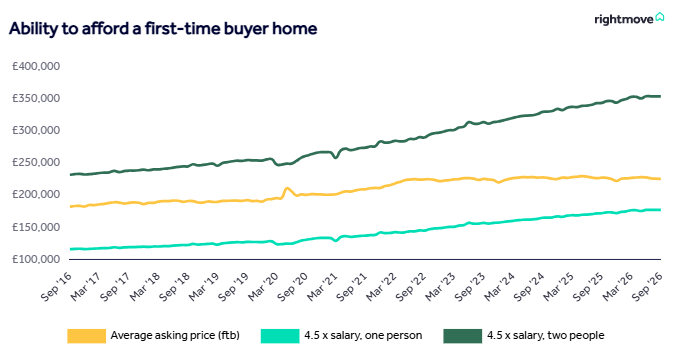
For buyers who have been saving or working towards a deposit, rising earnings may provide a little more breathing room in their budget and improve what they can comfortably afford. While this doesn’t remove affordability pressures overnight, it can help some buyers move closer to their homeownership goals.
Lenders have more flexibility in how they assess affordability
Recent regulatory and affordability assessment changes are also giving lenders greater flexibility when considering mortgage applications. This could create more opportunities for some buyers who may previously have found affordability checks difficult to pass. But it’s worth remember that the effect will vary between lenders and applicants, and it doesn’t mean that affordability requirements have been removed, or that an application is more likely to be approved.
Importantly, affordability is becoming less about a single headline income multiplier and more about a person’s overall financial position. Factors such as spending patterns, existing commitments and disposable income can all play a role in assessing what someone can realistically borrow.
That shift may help more buyers understand that borrowing capacity isn’t always defined by a simple multiple of their salary. Instead, lenders are increasingly looking at the bigger financial picture.
Evolving government schemes for first-time buyers could provide more options
Another potential source of support for prospective buyers hoping to get on the ladder are . The proposed could also lower one of the biggest barriers for some first-time buyers: the upfront deposit.
The Government says eligible buyers are expected to be able to purchase a participating new-build home in England with a 2.5% deposit, supported by a 20% government-backed equity loan with an initial interest-free period.
The full details, including who will qualify and what the equity loan will cost longer term, are still to be confirmed, but this provides additional options for first-time buyers to consider.
What first-time buyers should consider
So how do first-time buyers cut through the noise and focus on their goals? Matt explains what simple things buyers can do to understand their own buying potential in the current climate.
Look beyond headline mortgage rates
Mortgage rates remain an important part of the home-buying equation as they ultimately affect overall costs. However, they are other factors that influence affordability:
“Lending criteria, household income, deposit size and the range of mortgage products available can all play a role in determining buying power.”
As lending criteria continue to evolve, buyers may find that their options are shaped by more than just the rate they see in the headlines. For that reason, it can be helpful to view mortgage rates as part of a much bigger picture rather than the single deciding factor.
Understand your monthly budget
For many first-time buyers, a good starting point is understanding what feels affordable on a monthly basis.
That means looking beyond the property price and considering day-to-day living costs, future savings goals and the flexibility to deal with unexpected expenses. A mortgage payment needs to work not only today, but over the long term as circumstances change.
Focusing on a sustainable monthly budget can often provide a clearer picture of what is realistic than concentrating solely on maximum borrowing levels. This approach reflects how many buyers already think about affordability in practice.
Watch how lenders respond to regulatory changes
Lending criteria are not fixed and may continue to evolve as lenders adapt to regulatory changes and market conditions.
For buyers, that could mean a wider range of products becoming available, and greater flexibility in how affordability is assessed. People who may not have qualified for certain products in the past could find new opportunities emerging over time. But remember, changes will vary by lender and will not necessarily result in a wider choice of products, or a successful application. Eligibility and affordability will continue to depend on individual circumstances, and the lender’s criteria.
Keeping informed about these developments may help buyers understand the full range of options available to them when they’re ready to move forward.
Expect uncertainty to remain, rather than waiting for it to pass
It is very challenging to predict the future of the housing market and affordability. External factors such as inflation and global events can all influence buyer confidence, mortgage products and housing demand.
Understandably, many buyers are choosing to wait before making a move. From our survey, among those delaying a purchase, 57% were hoping for lower property prices and 37% said they were waiting for lower mortgage rates.
Buying a home is one of the biggest financial decisions most people will make, and it’s natural to want more certainty before taking the next step.
However, future market conditions remain uncertain. Property prices, mortgage rates and personal circumstances can all move in different directions over time. While waiting may prove beneficial for some buyers, it is not without risk.
“It’s still worth following what is going on with house prices, interest rates and what support there is for first-time buyers. But rather than focusing on factors that are difficult to control, buyers should focus on the things they can influence themselves.
Buyers who understand their budget and keep informed about available options are often in a stronger position to act when the right opportunity comes along,” concludes Matt.
Ultimately, building savings, strengthening their credit profile and developing a clear understanding of affordability can all help put them in a stronger position for the future.
The bottom line
Affordability pressures, market uncertainty and changing mortgage rates continue to influence decisions, so it’s understandable that many buyers are taking their time. At the same time, improving earnings, evolving lending criteria and a growing focus on practical affordability are creating opportunities that may not always be reflected in the headlines.
Looking to buy your first home? Our mortgage affordability tools are designed to help you get a clearer view of what you could borrow. See what homes you could afford with a Mortgage in Principle or estimate your monthly payments with our .
Please note: Your home may be repossessed if you do not keep up repayments on your mortgage. Rightmove is not authorised to give financial advice; the information and opinions provided in these articles are not intended to be financial advice and should not be relied upon when making financial decisions. Please seek advice from a regulated mortgage adviser.
Rightmove Living Room Pulse Surveys, June 2026 & July 2026; Rightmove House Price Index.