October in London has a particular charge. The city lights up with art and design, and the two things I care about most stop being separate disciplines and start a conversation. Having trained in architecture and sculpture, I see these worlds as inextricably linked.
PAD London, Frieze Sculpture, Frieze Masters and Frieze London offer four different ways of looking. Held in the same week and barely a mile apart, they encourage us to cross boundaries: between art and furniture, old and new, the precious and the experimental.
I’ll begin at PAD London, the only fair in the country given entirely to collectible design. Set within the intimate setting of Berkeley Square, from 13 to 18 October, it is a celebration of design, where tactile craft meets architectural form. A particular piece I am keen to see is Christopher Kurtz’s Skipping Stone table at Sarah Myerscough Gallery. He hand-carves different woods into smooth elliptical pebbles, balanced as though he has just stacked them by a river, inspired by skimming stones with his daughter.
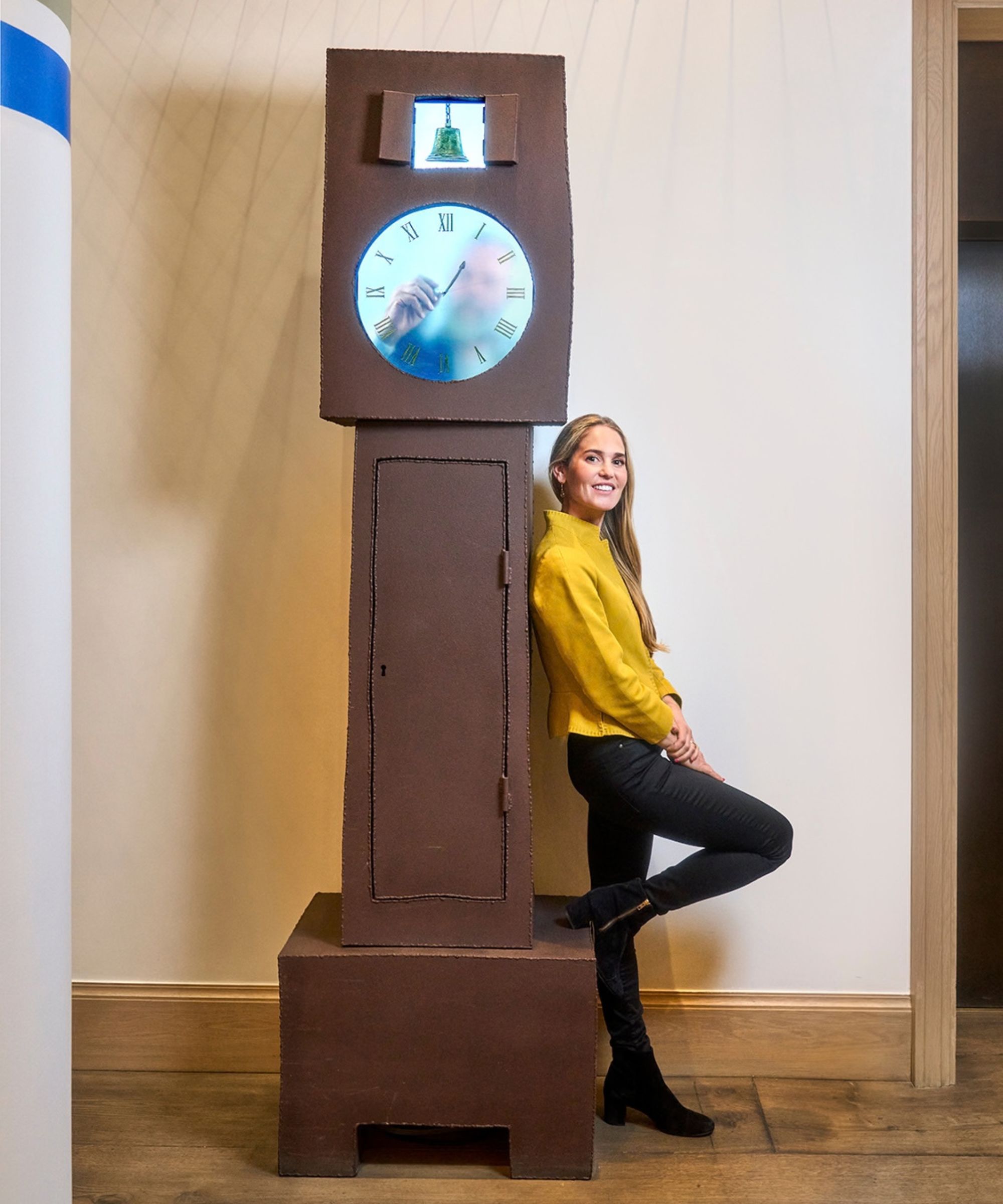
If his work catches your eye, head over to Sarah Myerscough’s gallery, where his solo exhibition, Badlands, is showing. I will visit Adrian Sassoon for Kate Malone’s incredible ceramics. The piece on display is from her Magma series, inspired by nature below ground, bubbling molten lava and crystals. It’s a joyful piece. Carpenters Workshop always displays cutting-edge work by globally recognised artists and makers; it’s where we found one of our favourite pieces, a Corten steel grandfather clock by Maarten Baas.
Then north to Regent’s Park for Frieze Sculpture, the free outdoor display set among trees. I am fascinated by how three-dimensional work behaves outdoors, where the scale of a piece changes entirely; the surrounding landscape becomes a participant in the art. You have the freedom to circle around a work, observing how light, shadow and sight lines shift with every step. It is where I feel most at home, and there are fewer crowds.
Conrad Shawcross, whose work I have admired since visiting his East London studio, will be on display. He combines the precision of engineering with the wonder of sculpture; ingenious structures governed by mathematics, yet full of movement and mystery.
Inside the tents at Frieze Masters this year, the curated threads are Spotlight, focusing on overlooked 20th-century artists; Reflections, taking inspiration from two extraordinary homes, Casa Luis Barragán and The Cosmic House; and Queering Modernism, which creates unexpected encounters across the fair.
Design expertise in your inbox – from inspiring decorating ideas and beautiful celebrity homes to practical gardening advice and shopping round-ups.
My trail begins at Hauser & Wirth, always a tour de force, bringing seminal historical pieces that set the bar for museum-grade quality. I will go to Philip Mould, where Duncan Grant’s painting of St Paul’s Cathedral combines two of my great interests: Bloomsbury and London itself. At Piano Nobile, you will be able to see a small alabaster Barbara Hepworth you can imagine holding, proof that a work does not need to dominate a space to have enormous presence.
At Ben Brown Fine Arts there will be some richly painted Frank Auerbach works. Do ask Hugo Cobb, senior director, for more information, because he brings each piece to life with fascinating facts. The gallery will be conveniently located near our pop-up Ham Yard Restaurant, featuring an uplifting yet tailored interior by Kit Kemp Design Studio.
Over at Frieze London itself, I go looking for names I do not yet know. The Artist-to-Artist section is a clever concept, where an established artist nominates a peer for a solo stand. This year, I’m interested to see Yinka Shonibare’s choice, Unathi Mkonto with Goodman Gallery, and Jeffrey Gibson’s Caroline Monnet with Blouin Division, whose work is built from tarpaulin, building membranes and thread, which is my kind of material thinking – the transformation of work-day materials. The new section, The Code Universe, and the Focus stands of younger galleries are, I find, the best places to make a discovery.
A few threads run through all of it this year. There is a real return to material-led craft, wood, plaster and stone, worked until they turn sculptural, and a fondness for natural, organic forms, such as the pebble and the boulder. And across Frieze Masters especially, art history and the present are in constant dialogue.
Most of us will be following our own trail for inspiration, with no intention of buying. Pick one thread and follow it, a single material perhaps, rather than drifting through hundreds of stands until it all blurs into one. Let something stop you before you read the label. Talk to the gallerists, who are all so knowledgeable. Keep a notebook or your phone camera to hand for the things that speak to you, because this is the way in which you slowly find your own handwriting. If you do want to start collecting, start with what you love, not with what you think you should. Buy the catalogue; you will return to it all year.
These fairs are laboratories for the home. They offer the best opportunity to genuinely look. Notice the plinths, wall colours, lighting and spaces between works. Whether you leave with a small piece by a maker no one has heard of yet, or with your eye calibrated, you will have spent the week well.